
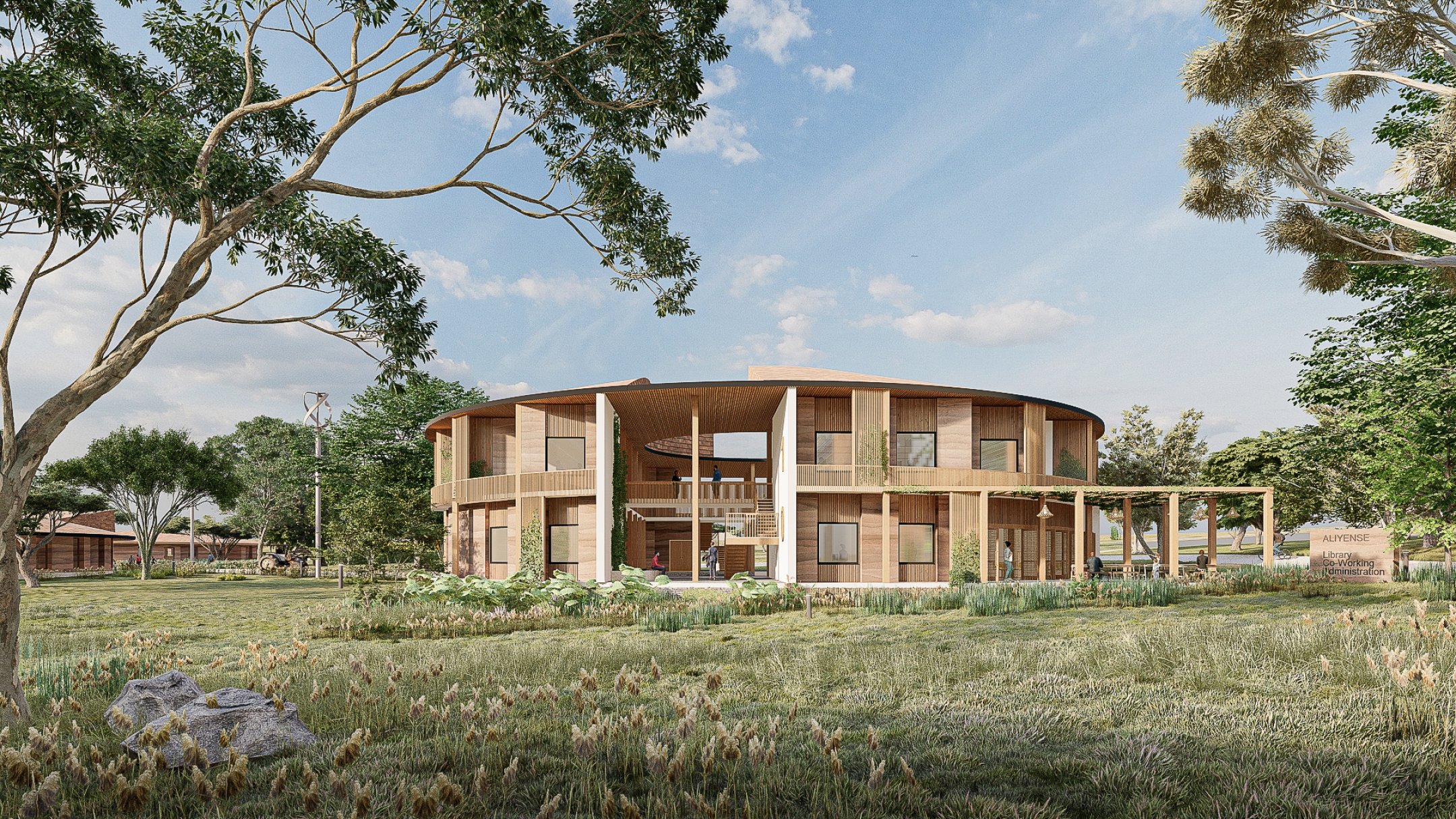
MWIC library

Moving Windmills Innovation Center

Year
2019
Status
In Progress
Size
185,300 sq m
Partners
Moving Windmills
Collaborators
Mazzetti, Peter Haase
Project Team
Cameron Bailey, Giovanni Bortolotti, Sylvie Dufitimana, Martine Dushime, Francis Fotsing, Symphorien Gasana, Joe Christa Giraso, Therese Graf, Azza Dushime Kagina, Anton Larsen Payá, Joel Muhozi, Aimable Mukire, Lysette Niragira, Paterne Niyonkuru, Annie Parker, Yussufu Renzaho, David Saladik, Aimé Patrick Twiringiyimana, Theophile Uwayezu, Christian Uwinkindi
Project Team
Cameron Bailey, Giovanni Bortolotti, Sylvie Dufitimana, Martine Dushime, Francis Fotsing, Symphorien Gasana, Joe Christa Giraso, Therese Graf, Azza Dushime Kagina, Anton Larsen Payá, Joel Muhozi, Aimable Mukire, Lysette Niragira, Paterne Niyonkuru, Annie Parker, Yussufu Renzaho, David Saladik, Aimé Patrick Twiringiyimana, Theophile Uwayezu, Christian Uwinkindi

The Moving Windmills Innovation Center is a hands-on, residential campus in Kasungu, Malawi, that empowers youth and local farming communities to become changemakers through sustainable design, entrepreneurship, and community-led innovation.

Co-founded by Malawian inventor and author William Kamkwamba, whose story inspired the film The Boy Who Harnessed the Wind, the Moving Windmills Project equips young people and farmers to respond to environmental and economic challenges with creative, human-centered solutions. Since 2008, the organization has fostered a culture of self-reliance, sustainable development, and rural ingenuity, transforming lives across 20 communities in the Kasungu region.

MWIC heart of campus

In Malawi, where small-scale agriculture dominates and access to education remains fragile, Moving Windmills is building a new, transformative education model. The Innovation Center will be a hub for the organization, featuring a hands-on, collaborative-learning residential campus that inspires African innovators to create local solutions to global problems. Rooted in design-thinking pedagogy, the Innovation Center blends hands-on learning with regenerative practice to unlock alternative pathways out of poverty—offering youth and rural entrepreneurs the tools, mentorship, and space to prototype real solutions for their communities

Learn more

The campus is designed to reflect the values of sustainability, community, and cultural relevance. Drawing on local materials and vernacular building traditions, the design centers around circular structures inspired by vernacular malawi villages and organized to encourage gathering, reflection, and connection.

Learn more
Learn more

Four core program areas—Ecology, Agriculture, Industry, and Community—anchor the Innovation Center, with purpose-built spaces for experimentation, collaboration, and cultural exchange. The campus includes hubs for making, learning, farming, living, and gathering: from fabrication labs and co-working classrooms to agroecological fields, communal housing, and an outdoor amphitheater. Together, these environments balance innovation with reflection—supporting academic rigor, personal well-being, and a deep sense of belonging.

Moving Windmills

The campus is designed to support environmental resilience and circular economies.  It uses low-carbon, locally sourced materials—such as earthen blocks and sustainably sourced timber—to reduce embodied energy while stimulating the local economy. The built environment integrates passive design strategies, off-grid infrastructure like solar energy, wind turbines, and composting toilets, and rainwater harvesting systems to minimize environmental impact.

MWIC machine shop

Beyond these programmatic zones, the Center invites personal exploration and reflection, with gardens and quiet outdoor spaces that restore the spirit as much as they stimulate the mind.

Landscapes are shaped to nourish both people and soil, demonstrating techniques like ecological restoration, no-till farming, and agroforestry that can be replicated across Malawi and beyond. MASS provided embodied carbon assessments and environmental performance guidance throughout the design process to ensure a truly regenerative approach.

Malawi

More than a school, the Moving Windmills Innovation Center is a living dynamo of energy and imagination—where young people can develop the confidence and capacity to lead. By fostering entrepreneurship, sustainable development, and grassroots innovation, the center creates alternative futures for learners and their communities.

Moving Windmills

With its deep roots in the land, culture, and knowledge of rural Malawi, the Innovation Center is a powerful model for how design, education, and community can come together to solve global problems—starting right at home.