
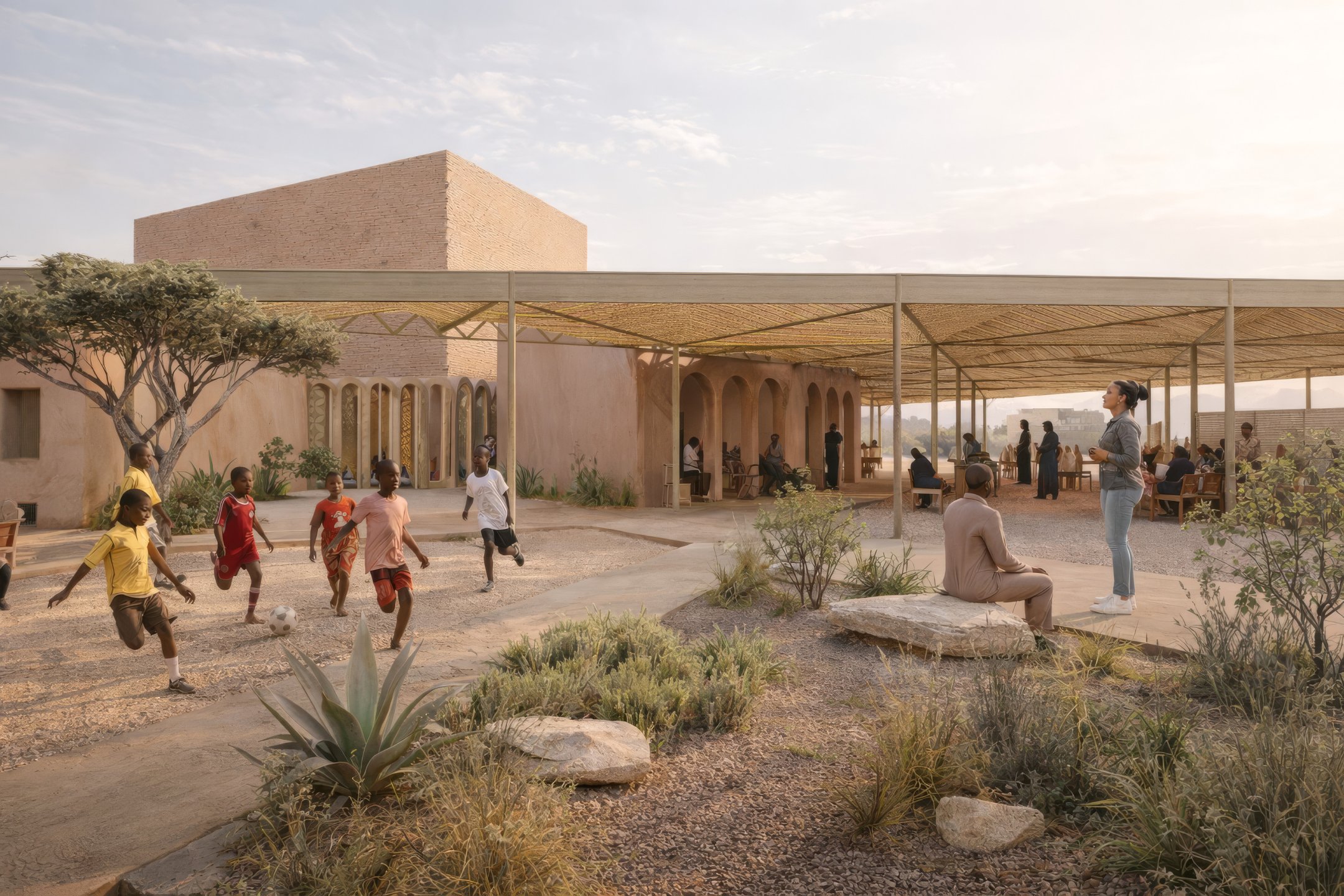
Iftin Peace Hub

The Iftin Peace Hub is a new model for post-conflict reconstruction in Somalia—an integrated campus where young people can heal, learn, build livelihoods, and reconnect with community.
The Hub brings together spaces for collective healing, skills development, entrepreneurship, and civic life under one roof. Since 2012, Iftin Global has worked to rebuild Somalia’s social and economic fabric by equipping young people with mental-health support, market-ready skills, and pathways to enterprise—proving that peace must be rooted in both healing and opportunity.
Somalia’s predominantly young population holds enormous potential, yet two-thirds face “waithood”—a prolonged period of unemployment, uncertainty, and exclusion. Without places to heal or pathways to belonging, many become vulnerable to despair, radicalization, or displacement. Current conditions make reintegration difficult—but they also highlight what is possible when systems of support, space, and imagination are rebuilt.


The Peace Hub is designed to unlock this opportunity—by rebuilding the conditions for imagination, connection, and shared futures.
With support from USAID’s American Schools and Hospitals Abroad (ASHA) Program, Iftin partnered with MASS to shape the first phase of the Peace Hub—a purpose-built center demonstrating how architecture, healing, and economic opportunity can come together to help young people rebuild their futures.
The Peace Hub will provide trauma-informed mental-health services and psychosocial counseling, helping prevent recruitment into violence and supporting the reintegration of at-risk youth and former combatants. By centralizing healing, learning, and economic opportunity, the Hub allows Iftin to double its reach and engage communities previously beyond its access.


Participants will gain literacy, vocational and business training, and certifications through Iftin’s programs—including gender-equity initiatives. They will also be connected to mentors and networks that support job placement, entrepreneurship, and small-business growth across multiple sectors.
Communal recreational spaces, including a football pitch and community gardens, will offer moments for pause and play. The design mirrors the Hub's multifaceted approach to peace, education, and community development. Each programmatic area is symbolized by a geometric shape—square, circle, and triangle—nested in the architectural plan.
- Square - Healing & Gathering: Central to the Iftin Peace Hub, the square signifies healing and gathering. It is a nurturing space for mental wellness and community unity, featuring areas for counseling, learning, and spiritual activities that foster a strong communal bond.
- Circle - Education & Entrepreneurship: Representing Education and Entrepreneurship, the circle encompasses learning and business development facilities, equipping individuals with skills for job success and financial autonomy.
- Triangle - Community & Landscape: The triangle symbolizes Community and Landscape, offering outdoor and social spaces such as playgrounds, sports fields, and gardens, promoting communal interaction and leisure.

By creating a welcoming place for healing, learning, and collective imagination, the Iftin Peace Hub will help young people in Somalia reconnect to community and become builders of peace, prosperity, and long-term stability.


Across the world’s conflict-affected countries, architecture has too often become purely utilitarian—reinforcing separation, fear, and control. The Iftin Peace Hub offers a different model for post-conflict reconstruction, showing how architecture can actively cultivate peace by creating spaces for healing, bringing people back into relationship with one another, and repairing a shared sense of possibility and collective imagination.
Mohamed Ali Diini, Founder & Director, Iftin Global


