
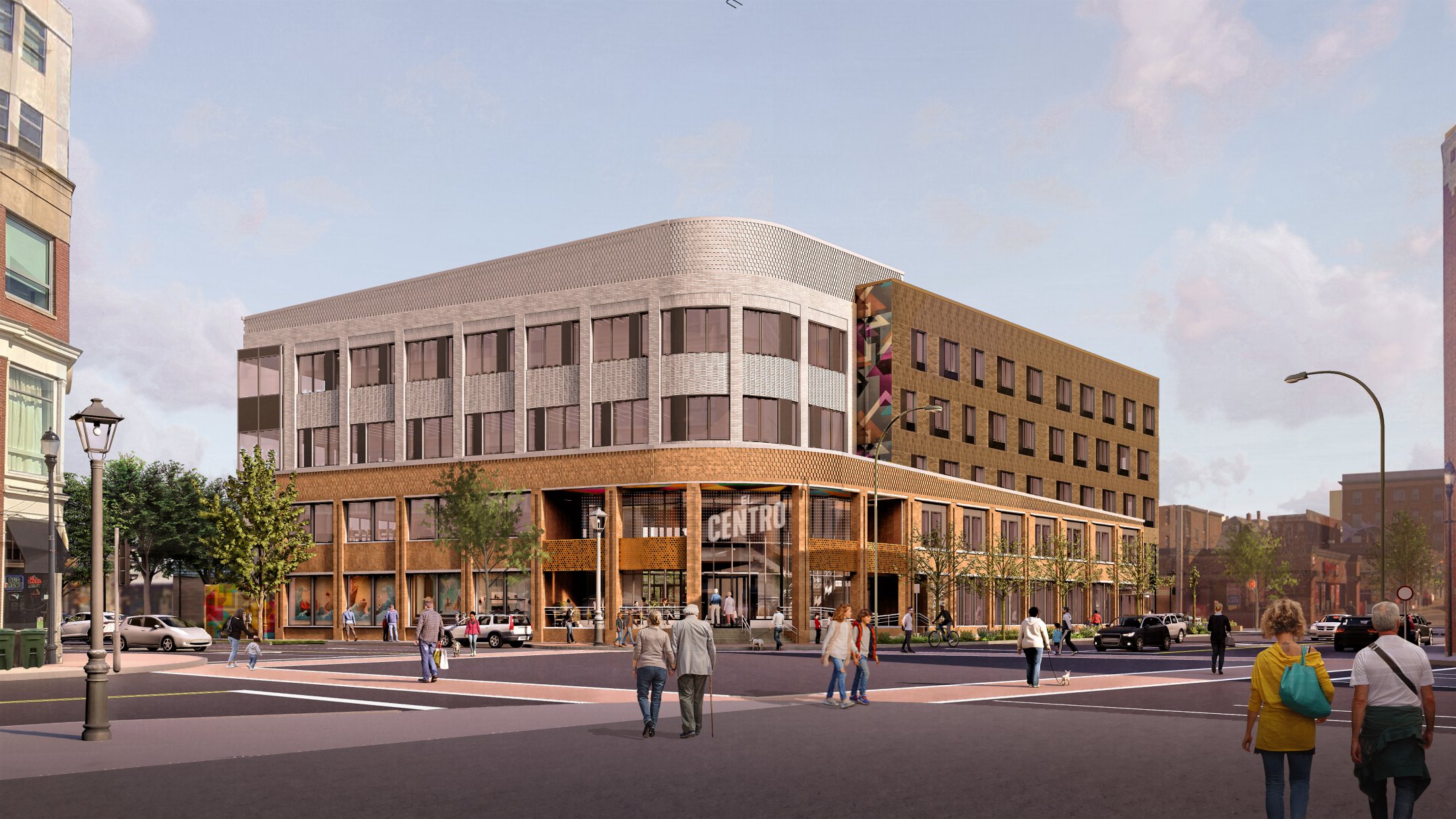
El Centro Housing and Health Center
El Centro brings together affordable senior housing units, a community health center, and transformative landscape improvements along Salem’s South River to address longstanding disparities in the El Punto neighborhood.
MASS is partnering with North Shore Community Development Coalition (NSCDC) and North Shore Community Health (NSCH) to develop a campus containing critical programs and services for Salem’s most vulnerable residents.
Located on the South River in Salem, MA, El Centro sits at the juncture between two historically contrasting neighborhoods, Downtown and El Punto. El Punto neighborhood residents are more likely to be crowded, have lower education prospects, and experience higher levels of financial distress than other Salem neighborhoods.


The development will include 48 affordable senior housing units, a 41,000 sq.ft. community health center, and vibrant landscape improvements to the adjacent harborwalk and streetscapes. The development of the new campus will increase jobs; improve health outcomes for residents through interconnected programs that facilitate community health, the arts, and resiliency; and ultimately support financial stability and long-term sustainability, enabling NSCDC and NSCH to continue to serve the needs of El Punto and downtown Salem.


El Centro weaves together climate responsive architecture, community building design strategies, and a focus on public art in order to affirm cultural identity, demonstrate environment stewardship, and create belonging.
The buildings will be Passive House certified and operationally 100% fossil-fuel free. The project also offers an exciting platform for art integration and viewing, further activating the South River and continuing the outdoor “Urban Art Museum” cultivated in the El Punto neighborhood over the last decade by NSCDC.

Expanded planting areas will soften the space, screen adjacent empty parcels, and increase biodiversity. El Centro is adjacent to a tidal river and the design also offers resiliency protection from flooding using several integrated and resilient design measures to help address potential climate-related events.
These include sea walls, berming, and floodable areas for water retention. The health center and residential units are, however, intentionally designed to be located well above the projected storm surge and sea level rise, and the ground levels of both buildings are designed to be completely floodable, with materials that can be easily cleaned and remediated.


