
The Willamette Falls Inter-Tribal Public Access Project

The Willamette Falls Inter-Tribal Public Access Project aims to reconnect Tribal communities to their heritage by restoring Indigenous access to sacred sites.
Willamette Falls has been a site for seasonal trade, fishing, and Tribal gathering for generations. Privatization and industrialization of the Falls area over the past two hundred years, as well as the genocide and relocation of Native communities, have severed members from this significant site. This project seeks to address the historical lack of public access by recognizing the shared cultural significance of Willamette Falls to a broad network of regional Tribes.


MASS is working with partners at Willamette Falls Trust to restore public access to Willamette Falls, creating new gathering spaces near the second-largest waterfall in North America and elevating the cultures and lifeways of the Indigenous people with connections to the land and water that have sustained the region for millennia.
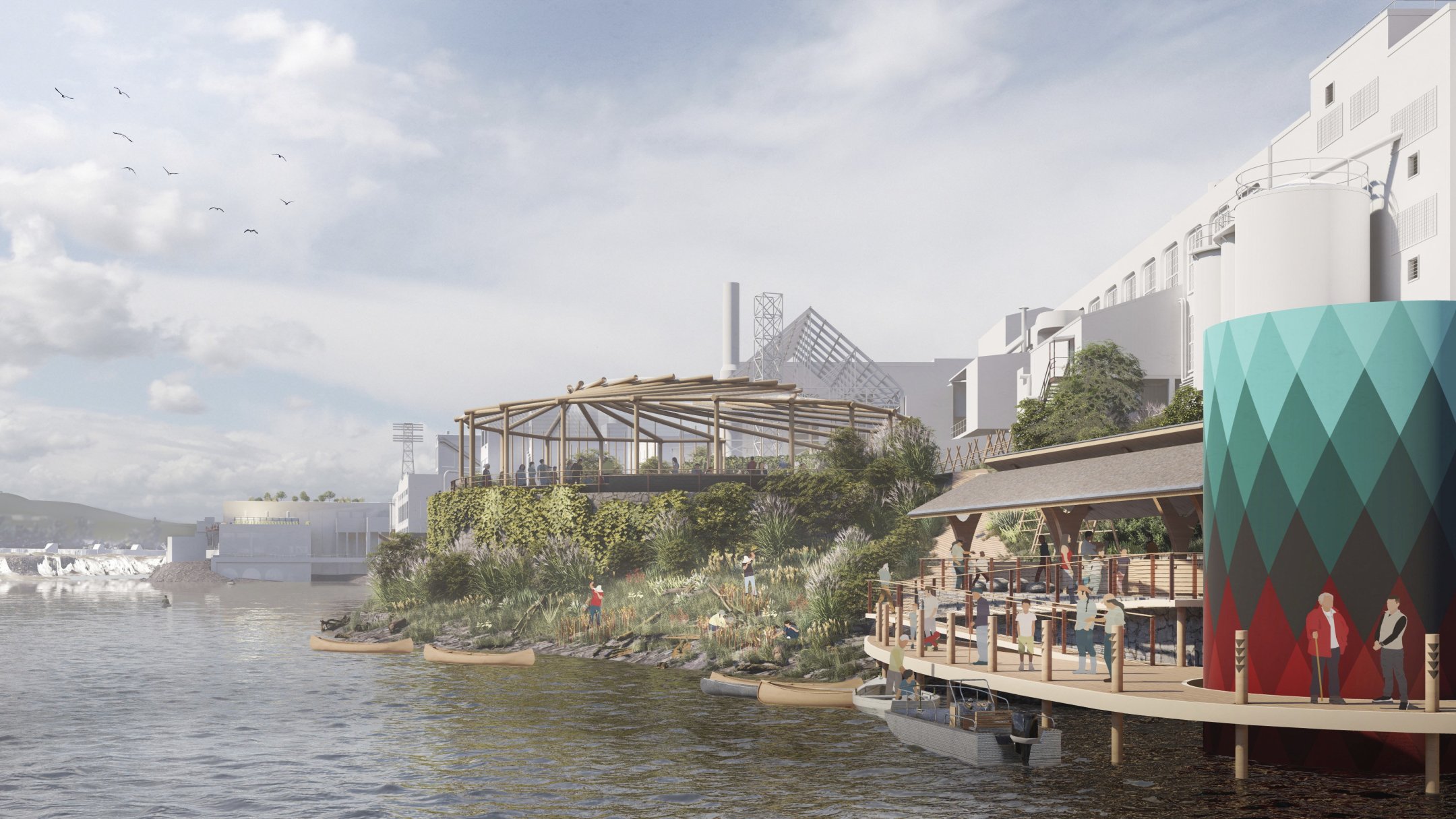
The project design, located on the island west of Willamette Falls, includes public walkways, viewing structures, and spaces for interpretation, cultural events, and community programming. MASS’s concept design was developed after several years of community engagement and programming work in collaboration with the Trust and Tribal communities.

“Willamette” comes from the Ichiskiin word walumpt, meaning blue water. Ripples, eddies, whorls, curves, and spirals—evoking the movement of water and plants—are the generative design concepts for the project. These biomimetic shapes from the river and native fauna, scaled to support community-prioritized activities, are featured across spaces to inspire pedestrian and spatial flows on the island site.
Engagement feedback from multiple local Tribes guided the Willamette Falls design process. Community priorities for the site are island and riparian revitalization and detoxification, opportunities for multi-generational Tribal/public education and economic development, and increased access to the falls for harvesting and fishing activities.
These priorities feature in the design of community gathering areas, flexible educational and entrepreneurship spaces, a lamprey harvest station, abundant native planting areas, and harvest and water access points.


The landscape approach, guided by engagement with Tribes and culture keepers, strives to understand both the presence and absence of key flora and fauna species. Other landscape strategies include native plant reintroduction, bioremediation, and the enhancement of wildlife corridors and habitats. Additionally, a plant teaching garden, bioswales, and rain gardens aim to revitalize the site's ecosystems while amplifying biodiversity.


In partnership with the Willamette Falls Trust, MASS facilitated a multi-year series of community engagement activities with Tribal communities to hear guidance on a range of values, meanings, and interpretations around Willamette Falls, while planning for proposed public use and enjoyment of access ways, spaces and amenities.
The Trust and MASS met with Tribal community members, Tribal Council members, and other individuals connected to the future of Willamette Falls, including the Confederated Tribes of Siletz Indians, Confederated Tribes of the Umatilla Indian Reservation, Confederated Tribes of Warm Springs, and the Confederated Tribes and Bands of Yakama Nation.


