
Standing Rock Cultural Center
Emerging from a history of occupation and extraction, the Standing Rock Cultural Center embodies resilience and renewal, a living testament to cultural resilience and the strength of place.
Rooted in the ancestral homelands of the Lakota and Dakota people, the Standing Rock Cultural Center is envisioned as a place of healing, learning, and cultural continuity. Positioned on the lower slope of a hill overlooking the rolling grasslands of the Standing Rock Reservation, the center connects land, sky, and story. It is envisioned as a living space where culture is not only remembered but practiced.
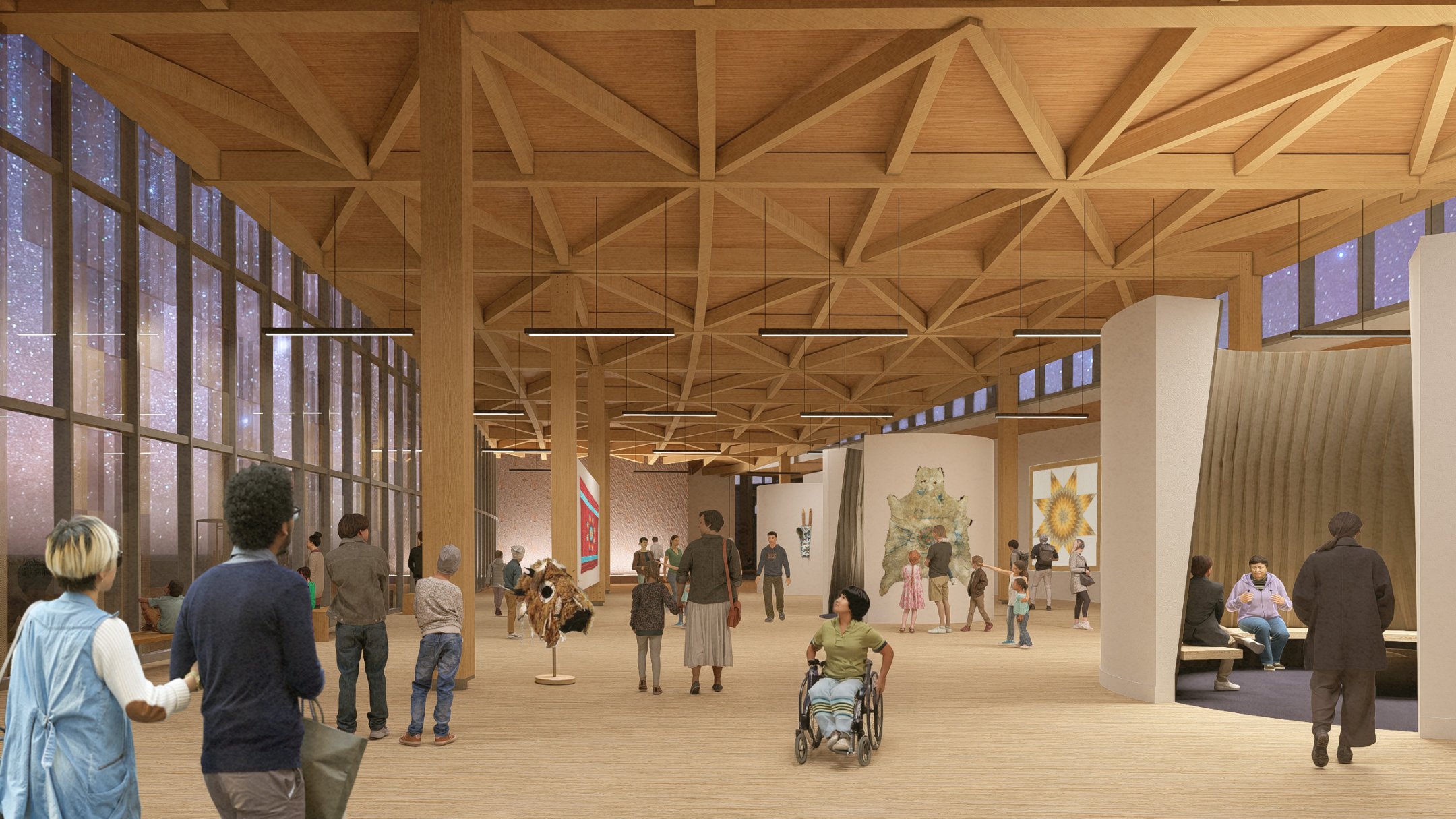
Drawing inspiration from the rhythm of quillwork and the layers of earth that tell the Lakota creation story, the architecture embodies reciprocity between people and place. The design integrates traditional forms with contemporary materials, bridging generations through craft and storytelling. Rammed earth walls, a glulam timber structure, and locally-sourced materials root the building in the landscape, while a solar field and passive systems sustain it for the future.


Form, function, and fabrication unite to bridge earth and sky, cultivating cultural knowledge and strengthening connections between people, place, and tradition.
Form, function, and fabrication unite to bridge earth and sky, cultivating cultural knowledge and strengthening connections between people, place, and tradition. The Cultural Center’s massing bridges earth and sky, embodying reciprocal relationships and the balance of compression and expansion. Its design creates a spatial experience that reflects the natural world, offering moments for ceremony, reflection, and connection to the land.
The Center will support intergenerational knowledge-sharing through research and teaching spaces, cultivating culture both orally and physically, and creating opportunities for learning, storytelling, and cultural preservation.

The building’s plan considers significant cultural orientations to the landscape, as well as technical requirements for cultural object processing, preservation, and interaction. The Main Gathering Hall is the center of community life, designed for ceremony, celebration, and shared use, open via large doorways to the south that fill the space with natural light. Adjoining workshop rooms function as neighboring individual spaces that can open into one large shared room. Each workshop connects to an outdoor cultural use area, allowing activities to flow between indoor and outdoor spaces.


As Above, So Below
Community members emphasized the importance of celebrating the connection between sky and earth, spirit and land. “As above, so below” reflects the Lakota belief that balance in the natural world is mirrored in human life. This idea shaped the Cultural Center’s design, aligning form and experience with celestial movement and the grounding presence of the land.

A community library offers quiet spaces for reading, research, and reflection. The space supports intergenerational learning and access to cultural resources while offering a space for stories to be shared and exchanged. Nearby, the Center’s exhibit spaces lift Lakota and Dakota voices through objects, images, and stories, with a flexible design that supports rotating exhibitions, immersive displays, and ongoing cultural reflection.

The site unfolds through gathering lawns, cultural use spaces, and interpretive star knowledge trails, guiding visitors through narratives of creation, resistance, and renewal. As a space for reclaiming cultural sovereignty, the center provides a repository for the return of cultural objects and the sharing of stories and lifeways. By reaffirming connection to land, language and community, this is a place where Standing Rock will root its future in the strength of its ancestors and the promise of generations yet to come.
The landscape balances programmable areas with ecological grassland restoration and environmental comfort through the use of shelterbelts. Active planting zones are located near entries, gathering spaces, and primary pathways. These dense groupings of native species provide seasonal color, and support pollinators, with additional passive planting areas designed to restore and support native prairie ecosystems with minimal maintenance. Using drought-tolerant, deep-rooted species, these zones help conserve water and stabilize soil, while encouraging biodiversity.

Community members emphasized the importance of celebrating the connection between sky and earth, spirit and land. The recognition of “as above, so below” reflects the Lakota belief that balance in the natural world is mirrored in human life. This concept shaped the Cultural Center’s design, aligning form and experience with celestial movement and the grounding presence of the land.
“This effort represents a touchpoint at a critical time in our history, a comprehensive look back to the wisdom of our cultural relationship with Unci Maka (Grandmother Earth) and how we put it into practice in contemporary times to keep the Lakota spirit alive to heal our world.”
— Joseph McNeil, CEO of SAGE Development Authority


