
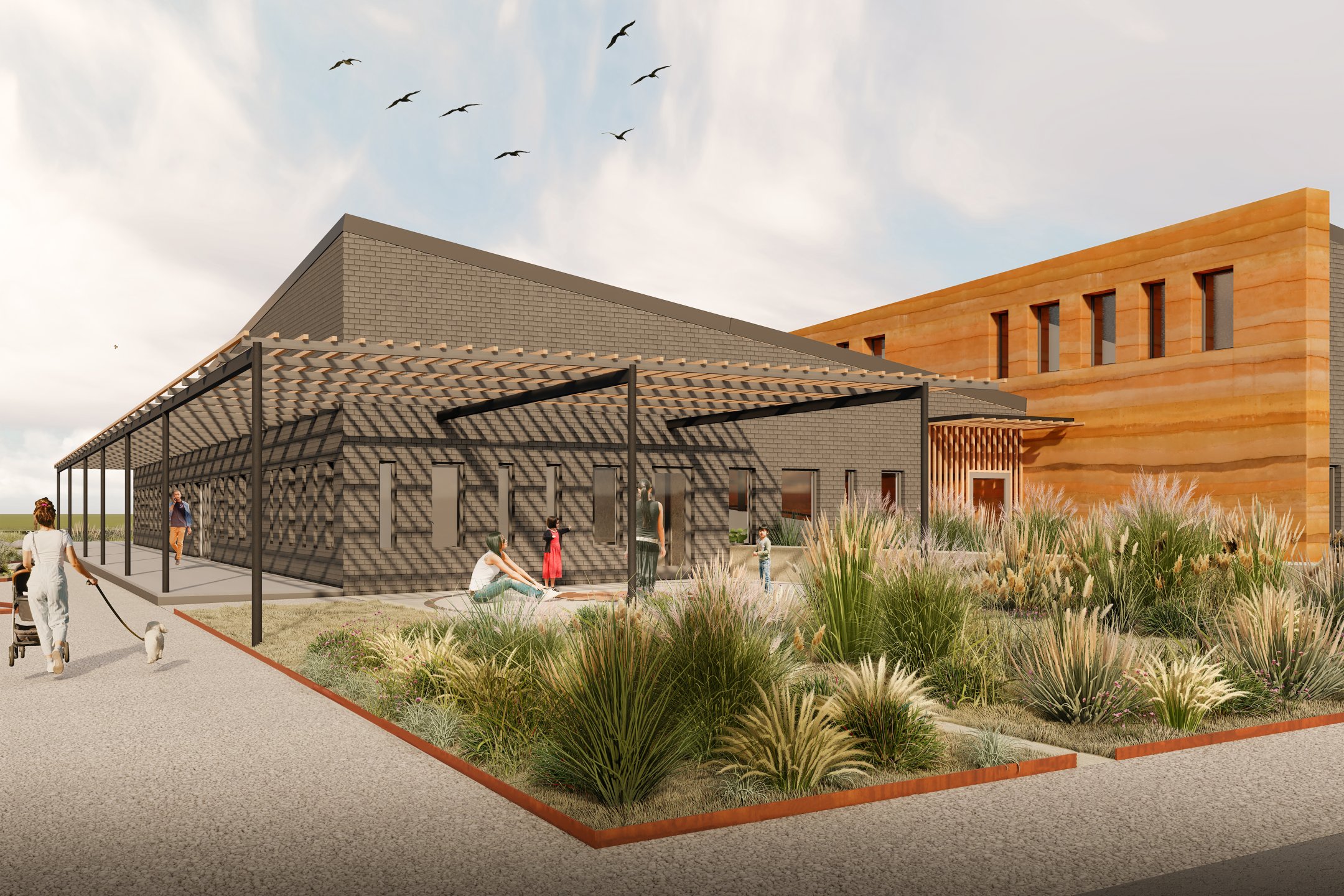
Native BioData Campus
The Native BioData Campus is a first-of-its-kind biobank and research center on Native land, designed to ensure that genomic and health research benefits Indigenous communities.
Developed, owned, and operated by the Native BioData Consortium (NBDC) in close collaboration with Cheyenne River Sioux Tribe agencies, the campus will support Native-led science while restoring relationships between land, people, and data through architecture grounded in cultural and ecological context.


Founded in 2010, NBDC is led by Indigenous scientists and Tribal members working to reclaim and reground the research, data, and biodiversity historically extracted from Cheyenne River Sioux and Indigenous lands worldwide. Located on the Cheyenne River Reservation in South Dakota, the campus will feature an 11,100 sq.ft. state-of-the-art research facility that hosts Native and non-Native scientists, students, nonprofits, service providers, foundations, and visiting Tribal governments. Seven on-campus housing units will accommodate short- and long-term residencies. A community playground, teaching gardens, and trail network will activate and restore the 9.9-acre site as a healthy grassland ecosystem.
MASS collaborated closely with NBDC and Cheyenne River Sioux Tribe leadership to co-design the campus, guided by community dialogue and cultural protocols. MASS’s film team also developed visual narratives to support storytelling and advocacy. The program, designed to balance the security of biodata with the desire for transparency and knowledge exchange, will invite audiences to engage with their data as they choose.


The architecture draws on the forms and materials of the Great Plains to cultivate deep sensory connections to the land. Rammed earth, a material and construction technique with historic roots in the region’s agricultural buildings, will form one of the primary walls of the main campus building, with stratified bands leading users up to a ceremonial space and down to the data storage area.
Berming, a traditional Indigenous Plains building method of embedding structures into the earth, harnesses thermal mass to moderate extreme temperature shifts. Earth excavated during construction will be used to shape berms that embrace the buildings, softening their edges and integrating them into the landscape. Sloped rooflines evoke the prairie’s rolling hills and drifting snow flows. Sacred orientations lead visitors from an east-facing entrance toward expansive western views, grounding the campus—and the science within it—in the sovereign power of land and people.

The design also centers resilience and sustainability. Disaster preparedness and carbon neutrality are supported through renewable energy systems, cyclical processing systems, redundant infrastructure, passive heating and cooling, and locally sourced, low-embodied carbon materials. The phased construction plan will uplift community labor, skills, and materials, ensuring that the project reflects and strengthens local capacity.


The campus landscape is an opportunity to help restore species intrinsic to the Great Plains eco-region, giving back to the land where it is grounded. Passive reseeding of native grasses can replace recently introduced invasive plants and help restore a diversity of original species to the land.
A boardwalk trail looping through the site will invite reflection, biodiversity exploration, and a deeper connection to the surrounding plains and sky. The northwest corner of the site will host a community playground and basketball court, providing a space for families to gather, play, and cultivate belonging.

Through Indigenous leadership and collective vision, the Native BioData Campus offers a new model for how science, land, and community can come together—anchoring innovation in place, sovereignty, and care.

