
The Northside Hub

The Northside Hub transforms a long-abandoned industrial site in Poughkeepsie, NY into a carbon net zero campus that models regenerative design, environmental justice, and equitable reinvestment.
This adaptive reuse project reimagines the Historic Standard Gage Factory—vacant since 2002 and located on a contaminated brownfield—into a vibrant, pandemic-resilient headquarters for Scenic Hudson, one of the nation’s most influential environmental organizations. The transformation includes a regenerative public landscape, auditorium, and commercial spaces, creating new civic and ecological assets for the community.

Since arriving in Poughkeepsie, MASS has worked closely with Scenic Hudson—a conservation leader in the Hudson Valley since 1963, known for preserving the historic Hudson River as well as regional lands and communities. Their River Cities Initiative targets restoration and revitalization in Poughkeepsie, Kingston, and Newburgh, aiming to redress historic injustices and ensure equitable access to environmental benefits.

In 2019, Scenic Hudson began its search for a new headquarters that would support its mission. MASS was engaged to accompany the process, including staff engagement, needs assessment, site selection, and feasibility studies. The Standard Gage Factory emerged as a compelling opportunity to physically connect the Walkway Over the Hudson to the Fall Kill Creek—an area long disinvested and disproportionately affected by poverty, homelessness, and systemic neglect.


The project embodies Scenic Hudson’s commitment to environmental and social regeneration. A new vertical atrium connects the organization’s core departments, enhancing collaboration and daylight access while preserving the historic character of the structure. Offices and meeting rooms are staggered within the open floor and along the perimeter to maximize access to operable windows. This thoughtful layout balances future functionality with preservation requirements.

Beyond meeting technical standards, the design transforms the building itself into a teaching tool. The integration of passive ventilation, daylighting, water-based perimeter heating and cooling, and trickle vents not only ensures a pandemic-resilient interior—ventilating at twice the code-required rate—but also creates an interactive relationship between users and the building’s systems. By directly experiencing how air, light, and temperature respond to their environment, occupants gain a redefined sense of comfort and a deeper understanding of ecological interdependence.


The Northside Hub is designed not only to reach carbon neutrality—where a building produces no more carbon than it emits—but to go beyond it, actually removing more carbon from the atmosphere than it generates. This is achieved by preserving the embodied carbon of the original load-bearing brick and concrete structure, minimizing the need for new materials, and focusing renovations on high-performance systems.
Operable, energy-efficient windows, improved insulation, a facade-integrated all-electric HVAC system that adapts to the climate, and rooftop solar panels drastically cut the building’s energy use. In addition, MASS partnered with SunCommon to pilot a low-carbon solar parking canopy system on-site. Together, these strategies ensure that the building not only reduces its own footprint but actively contributes to a healthier, more sustainable environment.


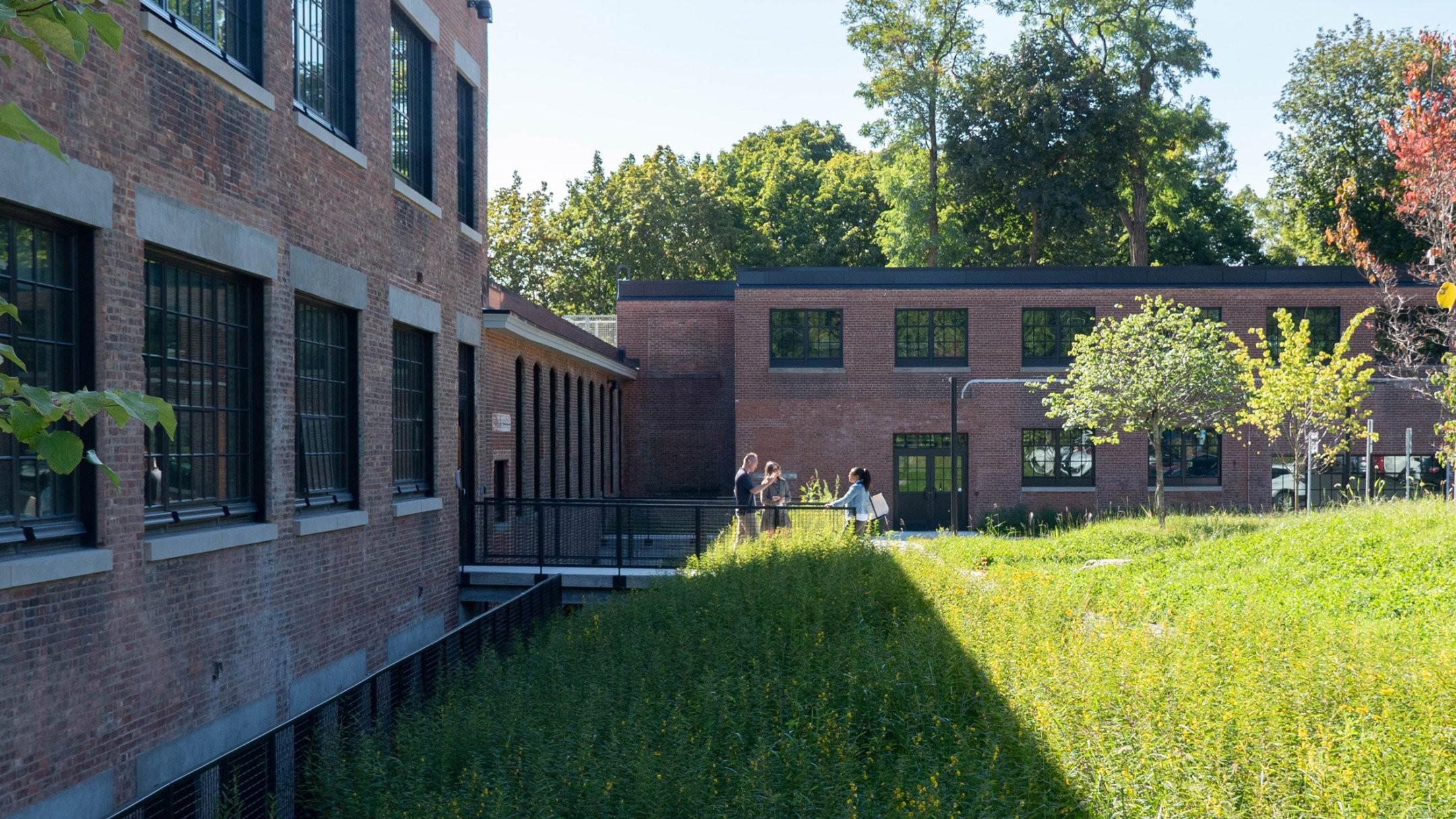
The landscape design remediates the brownfield by isolating contaminants and retaining stormwater on-site, reducing discharge into the adjacent Fall Kill Creek. This system also supports the growth of native plants and biodiversity while creating a public lawn for Northside Poughkeepsie visitors and residents. The site, which will be open to the public, shares the same commitment to community accessibility as the recently rejuvenated Malcolm X Park just upstream.
Scenic Hudson also established a 30% minimum requirement for local subcontractors in construction, ensuring that investment in the site delivers direct economic benefit to the surrounding community. The construction was completed in 20 months, engaging 33 regional companies and 240 regional hires.
The Northside Hub is not only a workplace—it is a model for how design can advance environmental healing, community well-being, and justice by transforming existing infrastructure into assets.


