
The Fall Kill Blueway
The Fall Kill Blueway is an initiative to transform an underutilized post-industrial creek that runs through the heart of Poughkeepsie into an asset and armature for regional climate resilience.
The Fall Kill is a tributary of the Hudson River that was originally the lifeblood for industry in Poughkeepsie, New York, once generating hydro-power for over 84 mills. It was channelized in the 1970s by the Army Corps of Engineers after surpassing its economic purpose and has since become an obscured and overlooked dumping ground. While the creek persists as a beautiful ecological asset teeming with life, the channel walls, approaching obsolescence, are now seen as a safety hazard. Yet, the Fall Kill still represents an incredible opportunity to think comprehensively about a regional resilience strategy in the face of increasing climate pressures. Its redevelopment will improve water quality and estuary health, provide new and accessible public spaces, and stimulate educational opportunities. As the historic artery of the city, its restoration is also an opportunity to stitch neighborhoods back together across dividing highways constructed during the urban renewal projects of the mid-twentieth century.


The project can be seen as an extension of the waterfront and an opportunity to bring assets, such as public space and access to nature, deeper into the heart of Poughkeepsie.
And while each node responds to unique social, environmental, and built site-specific conditions, the designs seek to maintain continuity through material choices, lighting, signage, and engineering. All design concepts accommodate the inclusion of a future “blueway” or pedestrian path along the Fall Kill that creates physical continuity between each site.


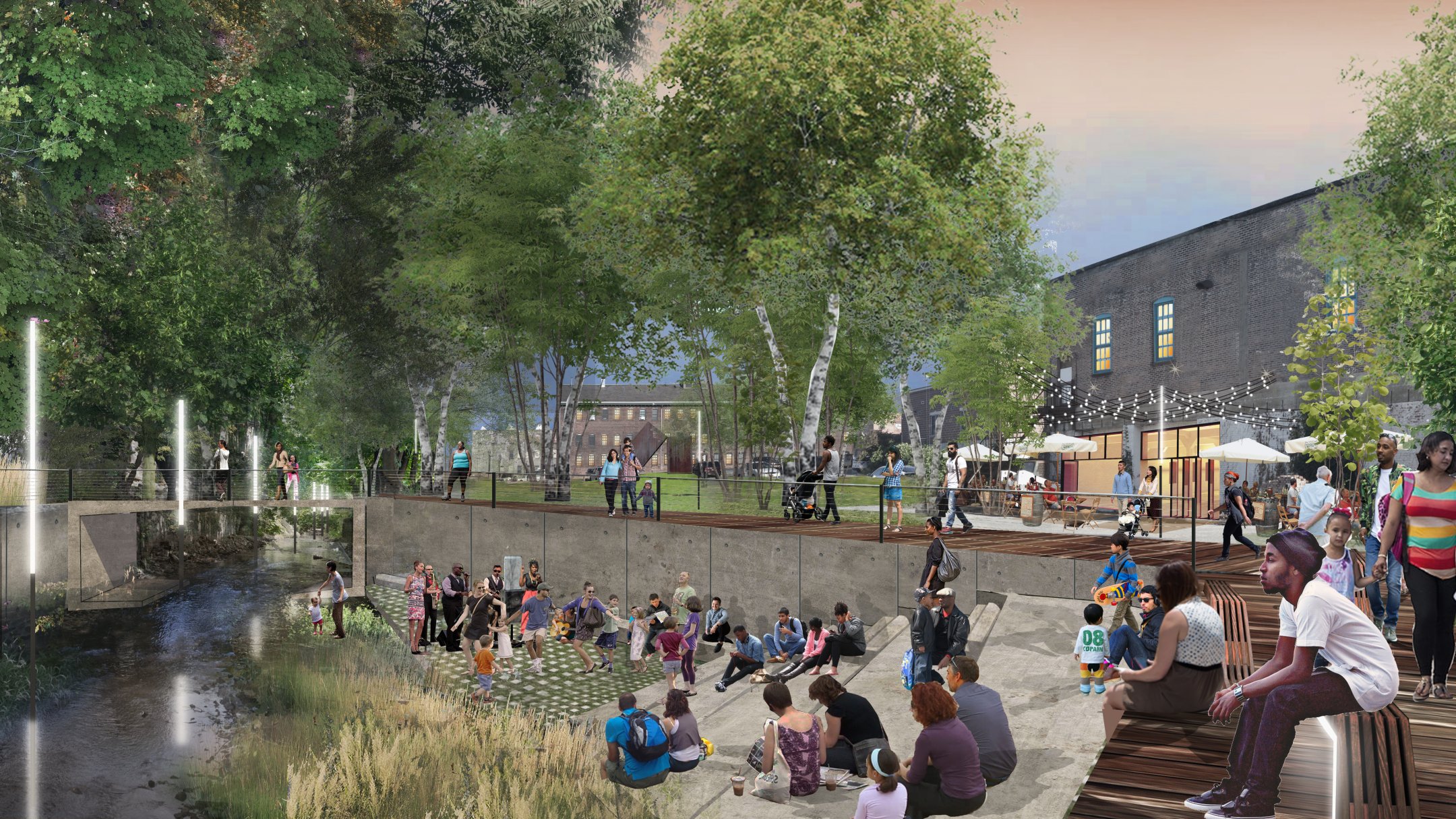
The Riparian Room, located on the property of the Family Partnership Center, incorporates green infrastructure and stormwater management into a currently impermeable and aging blacktop lot. Playful Shores is located behind the Family Partnership Center and proposes peeling back a towering wall to allow for creek access and enjoyment. Gathering Grove is another parking lot transformation that includes a ramp leading to the creek. Theatrical Creekside is located behind the Trolley Barn, a youth arts empowerment center and gallery. The proposed site project includes a terraced amphitheater and gathering space along the creek’s edge.


All concepts consider three factors: ecology, program and social impact, and engineering. While critically addressing the wall conditions and providing public space for local residents, the project is ultimately seen as an opportunity to foster ecological health and community resilience through strategies such as bioswales, constructed wetlands, native plantings, habitat restoration, permeable pavement, and natural shore stabilization. As temperatures in the city center rises, the creek will also provide local evaporative cooling opportunities.

The Fall Kill revitalization initiatives physically or programmatically connect many of our other partners in Poughkeepsie.
What began as an informal community-organized walk in 2017 has grown into a city-backed project that will leverage a grant from the state to develop five catalytic sites to address the Fall Kill’s flooding issues and improve public access to the Hudson River tributary.
In addition to our initial gallery exhibition in 2017, MASS has hosted two photography workshops with the local community college and professional photographer, Sean Hemmerle. These images went on display as part of another exhibition at the Trolley Barn in 2019. We also since held a storytelling workshop with Gerry Stropnicky and local residents.

The Fall Kill Blueway projects have evolved and branched out to become a part of several other initiatives, including the Northside Collaborative, a coalition of approximately 30 organizations and individuals working in education, employment, ecology, housing, and youth empowerment. These designs have become frameworks for coalescing efforts around improvements to Poughkeepsie’s Northside and addressing the need for regional climate resilience measures.


