
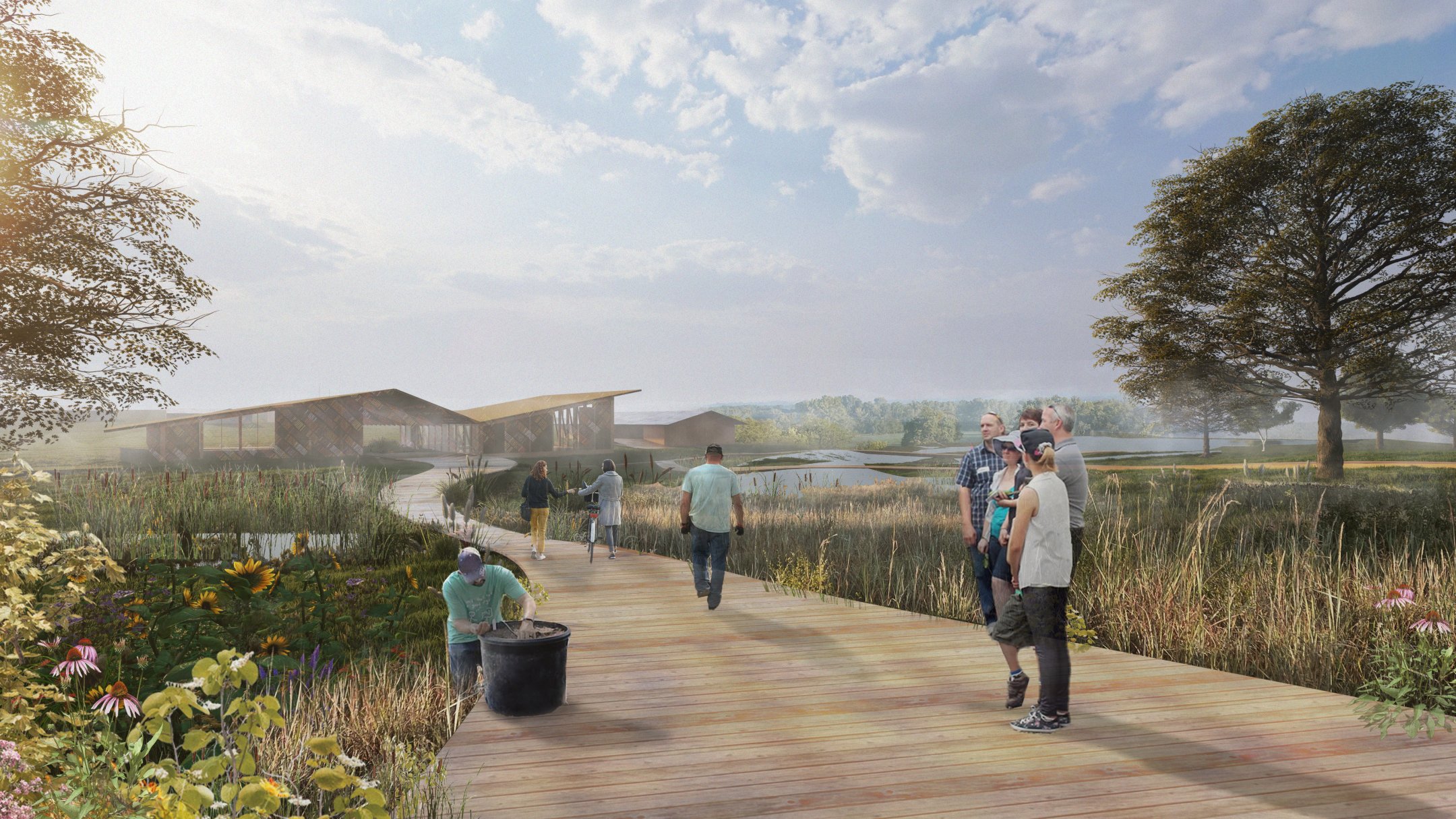
Land Institute Campus Plan

Developed in partnership with MASS, The Land Institute Campus Plan helps to re-elevate The Land Institute’s commitment to resilience, legitimacy, collaboration, and curiosity.
The Land Institute (TLI) has been at the forefront of perennial agriculture for nearly 50 years, practicing a critical mission to seed alternatives to industrial soil depleting arable farming by researching and developing perennial agricultural systems that sustain land and soil.
Industrial agriculture’s heavy dependence on chemical fertilizers, petroleum inputs, and annual crop rotations have led to soil degradation, habitat loss, and countless other environmental catastrophes. Nowhere is that more evident than in the Great Plains, where less than one percent of the original tallgrass prairie survives and where resultant flooding, drought, and denuded soils have dramatically lessened the region’s economic vitality and resilience to climate change.


In order to continue the urgent research and advocacy happening on The Land Institute’s Salina campus in the heart of the Great Plains, the staff and leadership of The Land Institute recognized the need to expand the campus’s physical spaces and infrastructure. The Land Institute also saw an opportunity to approach both organizational and infrastructural growth with great care and planning, in order to ensure alignment with the organization’s values.
With the support of MASS, The Land Institute team laid the groundwork for organizational growth to accompany the physical transformation of the plan. The planning process engaged staff members across the organization, from researchers and administrators, to facilities managers. This process provided an invaluable opportunity to probe the minds of the organization, bringing us closer together in the process.
MASS and TLI identified key design principles that would inform the form, function, and fabrication of the campus and its buildings. Together, these elements formed the basis for a Campus Plan and design that grounded users in the prairie, which seeks to gather staff and visitors together, and utilize design-knowledge to create spaces for research and learning that bring users joy, while being responsible stewards of the land.

By bridging the newly restored wetlands ecology, the connection between the Main Campus and recent property extensions provides a newly expanded site for immersive research and ecological observation—both by the TLI staff and for visitors. Embracing the seasonal flows of the groundwater as a key register in the land, and designing site circulation to interface directly with that seasonal flux, informed design concepts that ground the relationship between people and the land.
Initial phases will solve for the most urgent space needs; building out common spaces, workspaces, and research facilities that are most critical in the near term. This first phase would be the most intensive, emphasizing capacity-building and removing program and infrastructure bottlenecks that have previously hindered organizational growth and progress.

Future phases would further build out the facilities and capacity for both shared and dedicated research space. Establishing production, processing, and lab programs on the east-side of campus would lessen the pressure on existing facilities on the current main campus, while increasing the research potential of all programs.
Additional future phases will be an opportunity to engage more deeply with the land and establish large-scale connections to surrounding nature trails and the City of Salina. Programs and buildings in this final phase are subject to change, shaped by the growth of different research programs and also the changing needs of work and common space usage by staff.


