
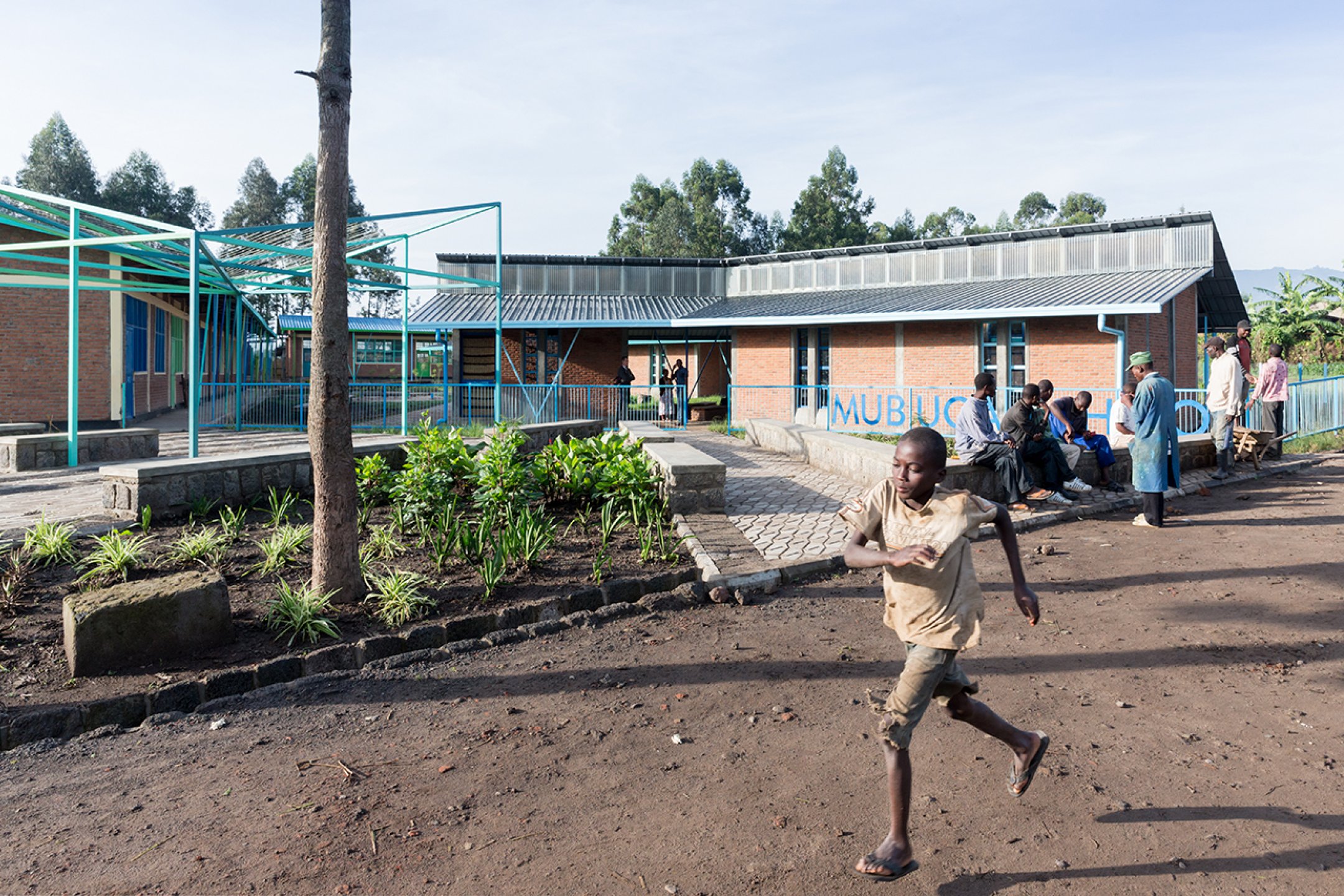
Mubuga Primary School
Mubuga Primary School pilots a scalable prototype campus design that improves learning environments and establishes updated national standards for public education infrastructure in Rwanda.
In 2013, MASS began a partnership with the Rwandan Ministry of Education and the M2 Foundation to renovate and expand Mubuga Primary School, a low-performing institution in Rwanda’s Musanze District. During an immersive pre-design phase, the team found that the school’s challenges in delivering quality education reflected broader systemic issues across Rwanda—and much of the African continent.

Alan Ricks
In 2003, the Rwandan Government eliminated primary school fees. While this policy significantly increased enrollment, it also led to overcrowded classrooms in poorly constructed and maintained facilities.
The Mubuga project aimed to address these challenges and others—poor lighting, inadequate acoustics, limited sanitation access—while staying within the Ministry’s financial and material constraints. The goal was to transform Mubuga into a space of learning, discovery, and joy, and to create a scalable model for future schools in Rwanda.
The new campus consists of five buildings with thirteen classrooms connected by a central pathway. Classrooms are larger and incorporate clerestory windows and extended roof overhangs for natural light and ventilation. Additional facilities include a teacher resource room, administrative office, library, community pavilion, and bathrooms that include separate, private, and hygienic washroom spaces for girls.


MASS
Outdoor spaces were designed to accommodate different age groups and genders, with play equipment made from local, sustainable materials like eucalyptus and recycled car springs—ensuring ease of repair and environmental responsibility. Sunken swales and native, water-loving plants manage surface water runoff through the valley.


Following construction, MASS collaborated with the Ministry of Education and the African Development Centre to study how the built environment affects educational outcomes.
The research tracked classroom and campus elements linked to improvements in academic performance, social engagement, and parent and community involvement; demonstrating that classroom and landscape architecture, along with a community-driven construction process, can better primary school education.
These findings later informed an educational design model that was applied to the Ruhehe Primary School in Ruhengeri, completed with the same partners and applying lessons-learned from the Mubuga Primary School.


The Mubuga Primary School serves more than 850 students each year. Both students and teachers report improved learning conditions, and government officials consider the school a national model for effective and inclusive education.


