
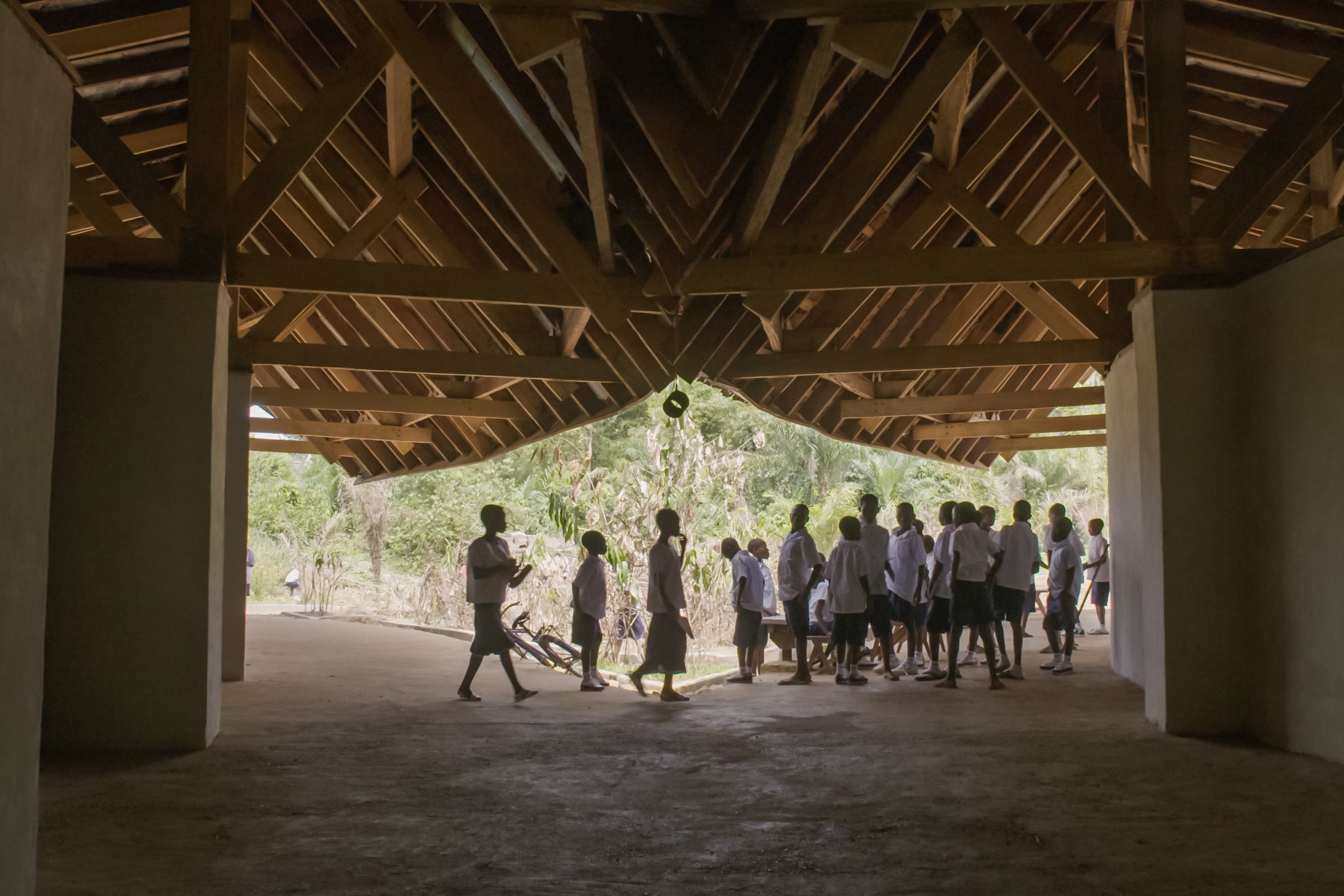
Ilima Primary School

The Ilima Primary School strengthens rural education while conserving threatened ecosystems. Built from materials sourced within a 10-kilometer radius, it was conceived as a living platform for learning, conservation, and community resilience—proving that abundance can be hand-crafted, hyperlocal, and deeply reciprocal.
Located in one of the planet’s most ecologically rich yet vulnerable regions, the Ilima community is among the most remote in the world. For generations, residents have lived in close relationship with endangered wildlife in the surrounding forest, but increasing development pressures have created tensions between population growth, agriculture, and conservation. The Congo Basin—the world’s second-largest rainforest—is disappearing at an alarming rate due to agriculture, logging, mining, and population growth, threatening biodiversity and endangering bonobos, a great ape species found only here. Despite the region’s natural abundance, many communities face persistent economic and food insecurity, relying on subsistence farming practices that undermine long-term sustainability.

To understand the community’s needs, MASS undertook an in-depth pre-design immersion, interviewing residents, observing daily life, and leading focus groups with local youth. This process included fieldwork in Ilima, as well as visits to Kinshasa and Djolu—the nearest AWF office, located six hours away by motorbike. These engagements informed not only the building’s physical form but also its role as a symbol of regenerative landscapes. Community members shared their aspirations for the new campus; while conversations with local masons, brickmakers, and transporters revealed skills and resources that could be mobilized to strengthen construction quality and generate lasting local benefits.


MASS envisioned Ilima Primary School as a threshold between forest and farmland—a living laboratory where students can study forest ecology alongside sustainable agricultural practices.
To reinforce this bridge between people and wildlife, the campus includes a dedicated entryway, community space, outdoor classrooms, and play areas. Inside, six classrooms, an office, a reception area, and a library are organized around a central courtyard, fostering connections across age groups and subjects.


Over an eighteen-month process of collaborative construction, carpenters, weavers, masons, and laborers quite literally brought the school out of the forest, using materials harvested on and around the site.
Nearly 94 percent of the building materials were sourced within a ten-kilometer radius. Builders worked alongside conservationists to harvest local trees for structural members and shingles, collect termite mound soil for adobe bricks, and gather reeds for doors and screens. The result was an environmentally conscious structure that emitted 307,000 kilograms less carbon than the global average for a school of similar size.

The project also generated significant local impact. MASS employed 120 workers from Ilima’s eastern Befale Territory—20 percent women—injecting resources into the local economy and providing skills training. Two Congolese architecture fellows were mentored in leadership roles, while craftspeople like master carpenter Camile from Djolu advanced local expertise through the complex fabrication of nine-meter trusses, interlocking timber joints, and custom furniture. The school’s distinctive curved roof and woven finishes emerged from close collaboration between design and construction teams, blending architectural intent with fabrication logic.


By intertwining education and conservation, Ilima serves as both a beacon of learning and a model for sustainable development in rural Africa.
Its architecture balances local materials with cultural continuity, and community aspiration with ecological stewardship. The school’s value lies not only in how little was taken from the land, but in how much was returned—to students, to craftspeople, and to the surrounding rainforest. It demonstrates how education, labor, and biodiversity can thrive together in harmony, reminding us that when rooted in place, learning itself can become a strategy for planetary healing.


