
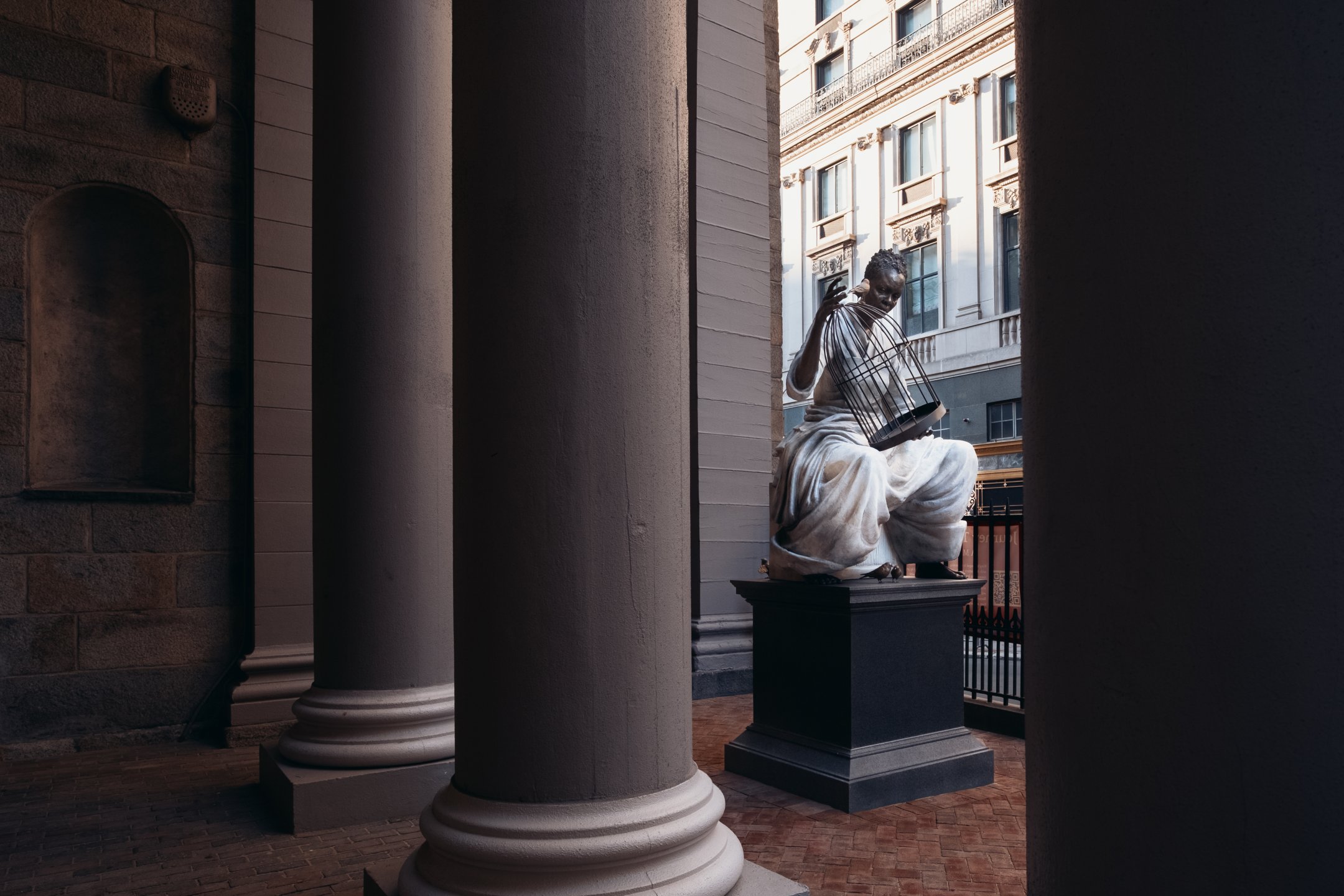
King’s Chapel Memorial to Enslaved Persons
Partners
King’s Chapel Memorial Committee & Congregation,
Harmonia Rosales
Photographer
MASS
Project Team
Bethel Abate, Jha D Amazi, Brandon Bibby, Sarah Dylla, Morgan O'Hara, Chris Scovel, Lucy Zuo
Video
Kelvin Adjei-Akosah, Antonieta Bocxe, Cristoforo Magliozzi
Project Team
Bethel Abate, Jha D Amazi, Brandon Bibby, Sarah Dylla, Morgan O'Hara, Chris Scovel, Lucy Zuo
Video
Kelvin Adjei-Akosah, Antonieta Bocxe, Cristoforo Magliozzi

The King’s Chapel Memorial honors the 219 enslaved individuals connected to the church’s history, creating a space of remembrance, reflection, and justice.
MASS partnered with the King’s Chapel Memorial Committee to design a memorial that acknowledges and honors the 219 individuals who were enslaved by ministers and members of King’s Chapel in Boston during the 17th, 18th, and early 19th centuries. The church, a national landmark, has publicly recognized that its founding and growth were made possible through the wealth generated by enslaved labor.


Harmonia Rosales

This process led to the selection of Harmonia Rosales, a Los Angeles–based Afro-Cuban artist, whose proposed memorial offers an uplifting, celebratory tribute consisting of three parts:
- Unbound—a figurative sculpture of a woman personifying freedom in the Chapel’s courtyard, holding opened birdcages that display a scroll containing the names of the 219 enslaved persons at her feet.
- Bronze birds perched at the church’s exterior and its grounds, representing free will, rebirth, and empowerment.
- An immersive ceiling mural inside the Chapel’s sanctuary, depicting Black and Native people releasing birds into the sky.
Together, these elements form a space of remembrance, reflection, and forward-looking justice.


